Guide · 8 minute read
Curcumin 95 Explained: What Does 95% Curcumin Mean?
What a 95% figure on a curcumin label actually describes, and how to read percentages, milligrams and serving sizes together.
Written by Farhan Baig, founder of Zamzam Wellness Herbs
Published: 24 August 2026
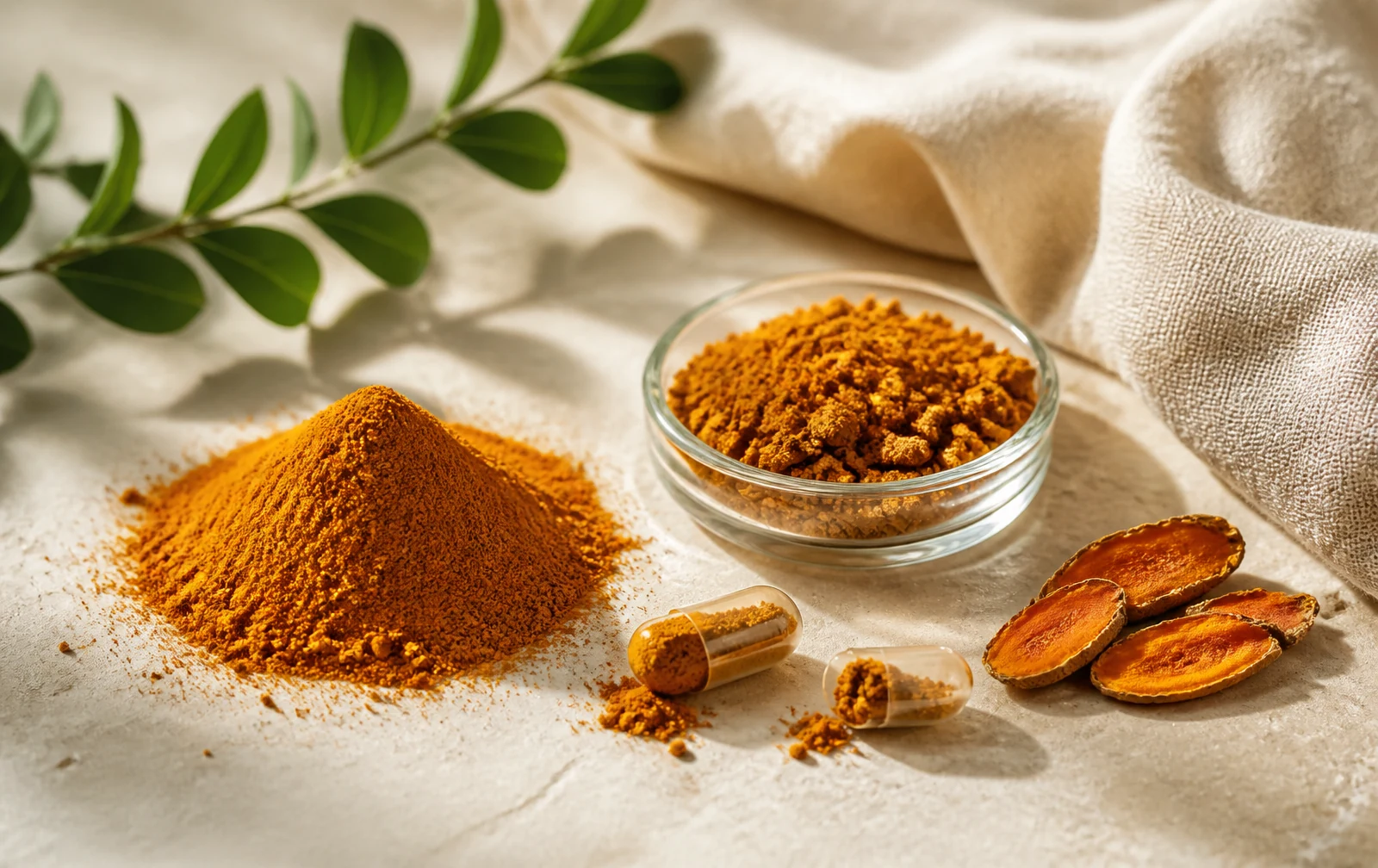
If you've compared curcumin supplements, you may have seen phrases such as “Curcumin 95”, “95% curcumin” or “95% curcuminoids”.
They sound straightforward, but they do not always tell you exactly the same thing.
The important questions are:
95% of what? How much extract is actually present? And is the figure stated per capsule or per daily serving?
Understanding those points makes it much easier to compare curcumin supplement labels properly.
First: curcumin and curcuminoids are not exactly the same thing
Turmeric comes from the rhizome of Curcuma longa.
It naturally contains a group of compounds known as curcuminoids. These include:
- curcumin
- demethoxycurcumin
- bisdemethoxycurcumin
Curcumin is therefore one curcuminoid, although the word “curcumin” is sometimes used more loosely when describing concentrated turmeric extracts.
This distinction matters when a label gives a percentage.
A study analysing 200 Indian turmeric accessions found curcumin itself ranging from 0.41% to 2.17%, while total curcuminoids ranged from 1.26% to 4.55%. The higher total includes curcumin together with the other principal curcuminoids.
So “95% curcumin” and “95% total curcuminoids” should not automatically be treated as identical descriptions.
What does a 95% standardised extract mean?
Botanical extracts can be produced so that the concentration of a specified constituent or group of constituents is controlled within a defined specification.
This is commonly described as standardisation.
Standardisation is useful because natural plant material varies. Growing conditions, variety, processing and extraction methods can all affect the composition of a botanical material.
Importantly, a standardised curcumin extract does not simply mean “stronger is better”. The figure describes how the extract has been specified and controlled.
Scientific literature on botanical extracts also stresses that a percentage alone does not completely describe an extract; factors such as the starting plant material, extraction method and other constituents also matter.
What would “500 mg at 95% curcuminoids” mean?
Here is a simple hypothetical example.
Suppose a manufacturer explicitly states:
500 mg turmeric extract, standardised to 95% total curcuminoids.
The calculation would be:
500 mg × 0.95 = 475 mg
So that 500 mg portion of extract would provide approximately 475 mg total curcuminoids.
But that calculation is only valid when the specification clearly confirms that:
- 500 mg is the weight of the extract, and
- 95% refers specifically to total curcuminoids.
If a label simply says “Curcumin 95% – 500 mg”, there is not enough information in those words alone to make that calculation confidently.
That is why percentage and milligram figures should be read together — and why precise terminology matters.
A real-world example: our Curcumin Supreme Trio label
Our own Curcumin Supreme Trio label currently states:
- Curcumin 95% — 500 mg
- Boswellia Serrata — 490 mg
- BioPerine® — 10 mg
The recommended use shown on the label is two capsules daily, and the bottle contains 120 capsules, equivalent to 60 two-capsule servings.
This is also a useful example of why we advise reading labels carefully.
The wording “Curcumin 95% — 500 mg” states a percentage and an amount, but the label wording by itself does not specify whether the 95% refers specifically to curcumin or to total curcuminoids.
For that reason, we do not simply convert our 500 mg figure into a claimed amount of total curcuminoids.
The underlying ingredient specification is the appropriate place to establish exactly what the percentage represents.
Transparency sometimes means saying what a label does not tell you, as well as what it does.
Curcumin 95 is not the same as ordinary turmeric powder
Turmeric powder and a concentrated curcumin extract are different materials.
Ordinary turmeric powder contains many naturally occurring components of the turmeric rhizome, with curcuminoids making up only part of its composition.
The study of 200 turmeric accessions mentioned earlier illustrates how much natural variation exists: total curcuminoid content ranged from 1.26% to 4.55% across the samples tested.
A curcumin extract 95 specification — around 95% of a particular curcuminoid fraction — is therefore compositionally very different from simply consuming the same weight of turmeric powder.
That does not mean one should automatically be described as “better” than the other. They are simply different forms of turmeric-derived material.
If you want the broader distinction between the spice, turmeric supplements and concentrated curcumin extracts, read our Curcumin vs Turmeric guide.
Why supplement terminology can become confusing
You might encounter descriptions such as:
- Curcumin 95
- 95% curcumin
- 95 curcuminoids
- Turmeric extract 95%
- Curcumin extract
- Turmeric extract equivalent to X mg turmeric
These phrases can look interchangeable when they appear on the front of a bottle.
They aren't necessarily.
The “equivalent to” phrasing in particular is unpacked in Turmeric equivalent mg vs curcumin extract.
Before comparing two products, ask:
What does the percentage refer to?
Does the specification identify curcumin itself, total curcuminoids or another marker?
What does the milligram figure refer to?
Is it the actual extract weight, the amount of a specified constituent, or an equivalent amount of the original plant material?
Is the quantity per capsule or per serving?
A product requiring two capsules per day cannot be compared fairly with a one-capsule product unless you compare the same serving basis.
Is an “equivalent” amount being used?
Some botanical supplements state the amount of raw plant material from which an extract was produced.
That number can be useful information, but it is not the same as saying that the capsule physically contains that weight of powder.
For sensible comparisons, look for the actual extract quantity and its specification.
Is 95% automatically better than a lower percentage?
No.
A percentage tells you something about the composition of that particular ingredient. It does not by itself tell you whether the finished supplement is better.
Consider two imaginary products:
- Product A: 100 mg extract standardised to 95%
- Product B: 500 mg extract standardised to 50%
Simply looking at “95%” would not tell you everything needed to compare them.
Likewise, a product advertising a very large number of milligrams tells you little if it is unclear whether that number refers to actual extract, raw-material equivalent or a daily serving.
A useful comparison therefore considers:
amount + specification + serving basis
rather than relying on the biggest number on the front of the pack.
What is BioPerine®?
BioPerine® is a branded black pepper extract made from the dried fruits of Piper nigrum.
Its manufacturer, Sabinsa, specifies BioPerine® as containing a minimum of 95% piperine.
From a label-reading perspective, that shows another useful distinction.
These descriptions are not necessarily equivalent:
- black pepper
- black pepper extract
- a standardised black pepper extract
When comparing formulations, check exactly what the ingredient description says and how much is included.
Our Curcumin Supreme Trio label lists BioPerine® at 10 mg. For more detail, read our BioPerine® and black pepper extract guide.
What is Boswellia Serrata?
Boswellia serrata is a tree whose gum resin is used to produce botanical extracts.
The resin contains a variety of naturally occurring compounds, including a group commonly described as boswellic acids.
Just as with turmeric, however, the words “Boswellia Serrata” alone do not tell you everything about an extract.
Two Boswellia ingredients may differ in their extract specification, standardisation and quantity.
We cover that subject separately in our Boswellia Serrata guide, rather than trying to turn one ingredient paragraph into a list of health claims.
A simple checklist when comparing curcumin supplements
Before choosing between two labels, check:
- What form is being used? Turmeric powder, turmeric extract or a curcumin-rich extract?
- How many milligrams of the actual ingredient are stated?
- Is a standardisation percentage given?
- What exactly is standardised — curcumin, total curcuminoids or something else?
- Are the amounts per capsule or per recommended daily serving?
- Does the product use raw-herb-equivalent figures?
- Are additional ingredients individually identified and quantified?
- How many servings does the bottle actually contain?
A clear label should make comparison easier, not simply present the largest possible number.
The key point
“Curcumin 95” is only meaningful when you understand what the 95% describes.
A percentage, an extract quantity and a serving size each answer different questions.
Read together, they can help you understand what a supplement actually contains.
Read in isolation, they can be misleading.
For more background on the difference between turmeric and curcumin, see our Curcumin vs Turmeric guide. As a practical next step, How to Read a Curcumin Supplement Label shows how to apply this when comparing products line by line.
To see the formulation discussed in our real-world example, visit Curcumin Supreme Trio.
Safety note
Food supplements should not be used as a substitute for a varied, balanced diet and a healthy lifestyle.
The UK Committee on Toxicity has reviewed turmeric and curcumin supplements and notes that supplement use can produce substantially higher exposure than normal dietary use. It also identified uncertainty and potential risks for some individuals, particularly in relation to high exposure, concurrent medicines and certain health circumstances.
If you are pregnant or breastfeeding, taking medication, have a medical condition or are under medical supervision, seek appropriate professional advice before using food supplements.