Guide · 9 minute read
Turmeric Tablets vs Capsules: What's the Difference?
What the words “tablet” and “capsule” actually describe, why they say nothing about what is inside, and the label information that does allow a fair comparison.
Written by Farhan Baig, founder of Zamzam Wellness Herbs
Published: 5 September 2026 · Last updated: 5 September 2026
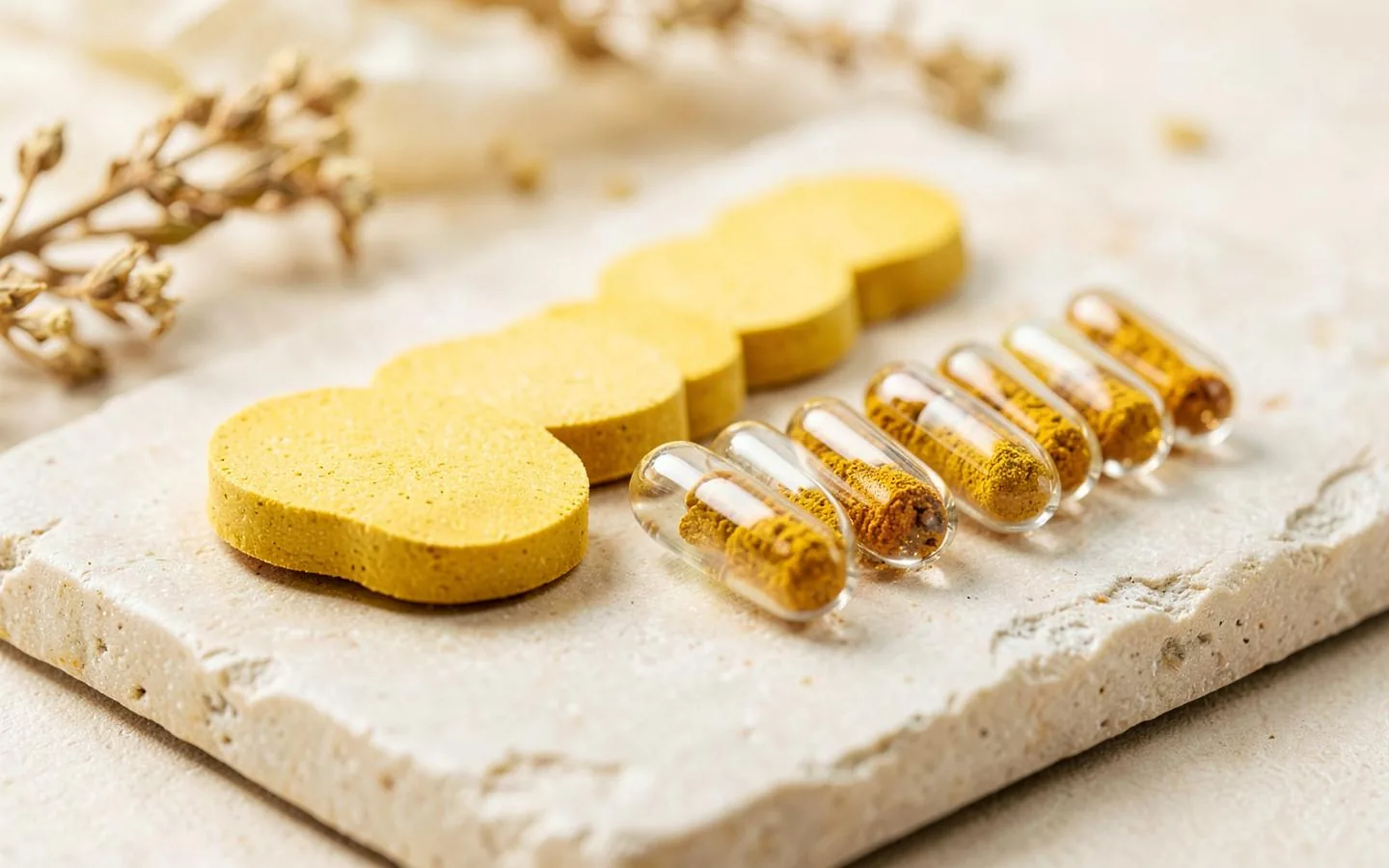
“Turmeric tablets” and “turmeric capsules” are two of the most common ways UK shoppers search for this category. In practice they are usually shopping shorthand for the same idea: a turmeric supplement.
But the two words describe the dosage form — how the material is presented — and nothing more. Neither tells you what ingredient is inside, how concentrated it is, or how much of it there is. Those answers are on the ingredient panel, and that is where a fair comparison starts.
What is the actual difference between a tablet and a capsule?
- A tablet is a compressed solid dosage form. The ingredient material is pressed into shape, generally with binders, fillers or coatings as needed to hold the tablet together and allow it to be manufactured consistently.
- A capsule is an ingredient enclosed within a capsule shell. The shell may be plant-derived or gelatine-based, depending on the product.
That is the whole distinction. Neither word tells you whether the filling is whole turmeric powder, a turmeric extract or a curcuminoid-rich extract, nor how many milligrams of it the product contains. We make no claim that either form is better, stronger or faster than the other.
Whole turmeric vs turmeric extract vs curcumin-rich extract
This is the distinction that actually changes what you are buying:
- Whole turmeric powder — the dried, ground rhizome of Curcuma longa, with a naturally modest curcuminoid content.
- Turmeric extract — a concentrated preparation of the rhizome. The word “extract” alone does not state the concentration.
- Curcumin or curcuminoid-rich extract — an extract concentrated so that curcuminoids make up a stated proportion of the material.
Two capsules — or two tablets — can contain any of these. That ingredient-form distinction matters far more when comparing labels than whether the product is pressed or encapsulated. Our Curcumin vs Turmeric guide sets the three apart in detail.
What does “Curcumin 95” mean?
“Curcumin 95” is category shorthand for an extract described with a 95% figure. A percentage is only meaningful when it is read together with two other things: what the percentage refers to, and the stated amount of material it applies to.
Where our own label states “Curcumin 95% 500 mg”, we present that as the amount listed on the label and do not interpret it as 500 mg of pure curcuminoids. Curcumin 95 Explained covers this in full.
Actual milligrams vs “equivalent to” milligrams
Turmeric tablets and capsules alike often carry a large milligram figure described as a raw herb “equivalent”. That figure is not dishonest — it simply describes a different quantity: the amount of starting plant material the extract is calculated to correspond to, using a conversion ratio.
What it is not is the physical weight of material inside the capsule or tablet, which is stated separately and is usually far smaller. Keeping the two apart is the single easiest way to avoid comparing two products on different terms — see Turmeric equivalent mg vs curcumin extract.
Turmeric with black pepper: what the label wording means
Black pepper appears across this category, described in several different ways. They are not interchangeable:
- “Turmeric with black pepper” — a general front-of-pack phrase; check the ingredient panel to see which pepper ingredient is actually listed.
- Black pepper — the ground culinary spice.
- Black pepper extract — a concentrated preparation of Piper nigrum fruit.
- Piperine — a compound found in black pepper.
- BioPerine® — a branded, standardised black pepper extract from a specific manufacturer, supplied to a defined specification.
The presence of pepper on a label is a formulation fact, not a performance figure, and we make no claim about what it does. Our guide Why black pepper extract is used with curcumin and the BioPerine® / black pepper extract ingredient page explain the wording further.
Per capsule or per serving?
Capsule and tablet counts are easy to compare and often misleading on their own. Some labels state amounts per capsule or per tablet, others per daily serving of two or more.
A bottle of 120 capsules with a suggested use of 2 capsules daily provides 60 servings, not 120. Before comparing any two figures, put them on the same basis. Our guide to reading a curcumin supplement label works through the panel line by line.
How to compare turmeric tablets and capsules fairly
| What to check | What it tells you |
|---|---|
| Dosage form | Whether the product is a compressed tablet or an encapsulated powder. A preference, not a measure of quality. |
| Ingredient form | Whole turmeric powder, turmeric extract or curcuminoid-rich extract — compositionally different materials. |
| Actual extract weight | The milligram amount of material stated on the label. |
| Standardisation percentage | Only meaningful once the label states what the percentage refers to. |
| “Equivalent to” mg claim | Describes starting plant material via a conversion ratio, not the weight in the tablet or capsule. |
| Companion ingredients | Each additional botanical has its own name, form, amount and specification to read. |
| Per-capsule or per-serving basis | Two labels can only be compared once both figures sit on the same basis. |
| Tablet or capsule count and total servings | 120 capsules at 2 daily is 60 servings — the serving is the honest unit. |
| Suitability statements actually on the label | Vegan, vegetarian and allergen information should come from the pack itself. |
Read down that list and one thing becomes clear: the dosage form alone does not determine which product is right for someone. It is a practical preference — how you like to take a supplement — sitting alongside the ingredient information that actually differs between products.
For the wider category view, including single-ingredient and multi-botanical formulas, see our guide to comparing turmeric and curcumin supplements in the UK.
Where Curcumin Supreme Trio fits
For transparency, here is our own product against the same checks. Curcumin Supreme Trio is a capsule product, not a tablet product, and the figures below are the amounts as listed on the current label:
| Dosage form | Vegan capsules | |
|---|---|---|
| Curcumin 95% | 500 mg | Amount listed on the label |
| Boswellia Serrata | 490 mg | Amount listed on the label |
| BioPerine® / black pepper extract | 10 mg | Amount listed on the label |
| Pack | 120 vegan capsules | |
| Suggested use | 2 capsules daily | |
| Servings | 60 |
These are the amounts listed on the label and are not stated per capsule unless separately confirmed. “Curcumin 95% 500 mg” is not being interpreted here as 500 mg of pure curcuminoids.
The full formulation is set out on the Curcumin Supreme Trio product page.
Frequently asked questions
Are turmeric tablets and turmeric capsules the same?
Not necessarily. Those words describe the dosage form only — pressed or encapsulated. What is inside, and in what amount, is set out in the ingredient panel, and it can differ substantially between two products of the same form.
Are capsules better than tablets?
We make no such claim. Both are established dosage forms and the choice between them is a practical preference. What differs between products is the ingredient, its stated amount and how clearly the label sets both out.
Is curcumin the same as turmeric?
No. Turmeric is the rhizome of Curcuma longa; curcuminoids, of which curcumin is one, are compounds found within it. A curcumin extract is a concentrated preparation rather than the whole spice.
What does “turmeric with black pepper” mean?
It is a general front-of-pack phrase. The ingredient panel will state which pepper ingredient is actually used — ground spice, black pepper extract, piperine or a branded standardised extract such as BioPerine® — and at what amount.
Should I compare the capsule count or the serving size first?
The serving. Capsule or tablet count only becomes comparable once you know the suggested use: 120 capsules at 2 daily is 60 servings, while 120 capsules at 1 daily is 120 servings.
Can I take turmeric supplements with medication?
Food supplements can interact with medicines, and individual circumstances vary. Anyone taking medication, under medical supervision, pregnant or breastfeeding should seek advice from an appropriate healthcare professional before using a food supplement. We are not able to give medicine-specific guidance.
Safety note
Food supplements should not be used as a substitute for a varied, balanced diet and a healthy lifestyle.
The UK Committee on Toxicity has reviewed turmeric and curcumin supplements and notes that supplement use can produce substantially higher exposure than normal dietary use. It also identified uncertainty and potential risks for some individuals, particularly in relation to high exposure, concurrent medicines and certain health circumstances.
If you are pregnant or breastfeeding, taking medication, have a medical condition or are under medical supervision, seek appropriate professional advice before using food supplements.