Guide · 8 minute read
Curcumin and Boswellia Explained: Why They Appear Together in Supplements
Two different botanical ingredients, one shared formula space — and how to read both on a supplement label.
Written by Farhan Baig, founder of Zamzam Wellness Herbs
Published: 5 September 2026 · Last updated: 5 September 2026
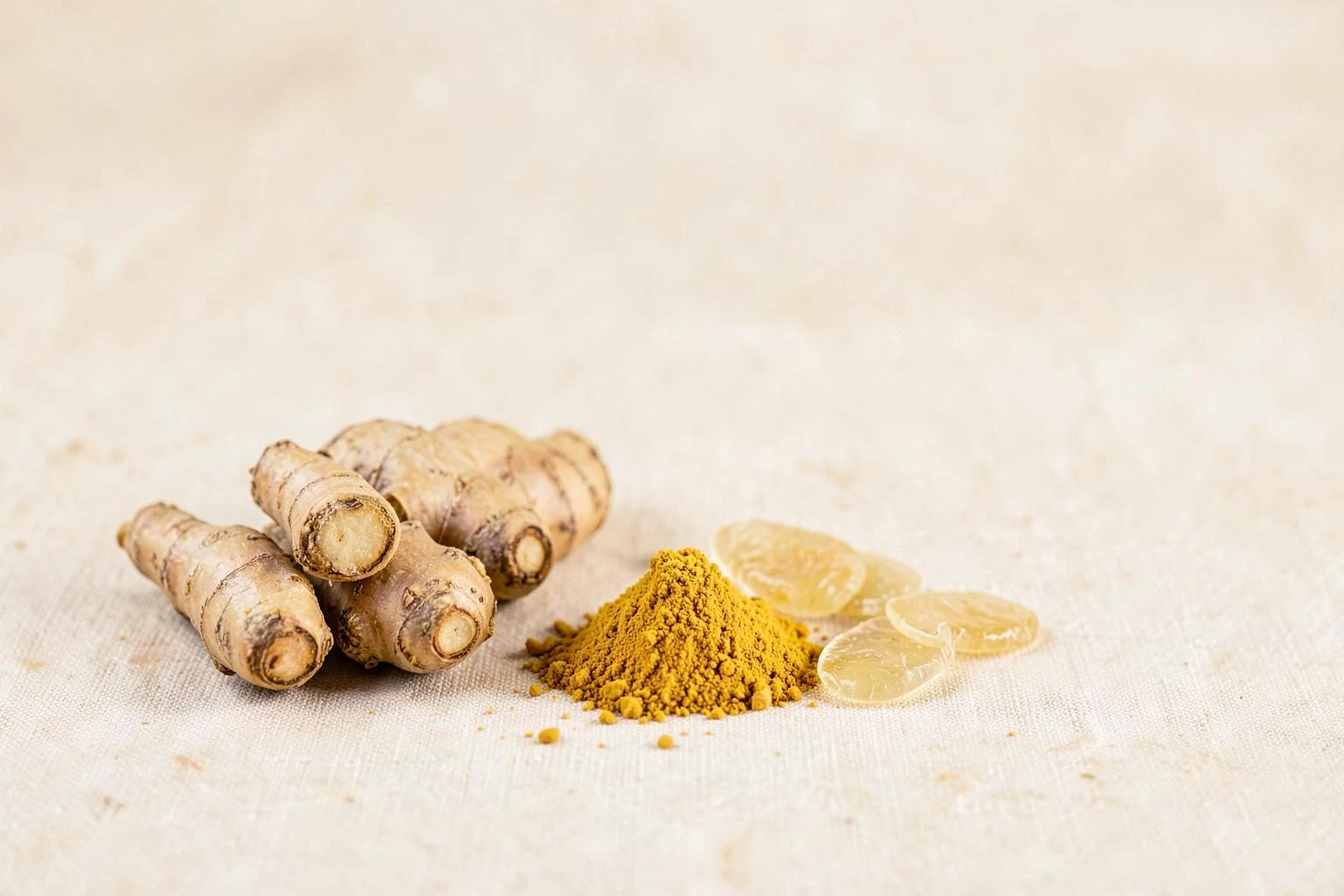
Curcumin and Boswellia are different botanical ingredients that are often combined in the same supplement formula.
Curcumin is derived from turmeric. Boswellia serrata is a resin-producing tree used in traditional Indian botanical practice.
They are not the same ingredient, and the percentages and milligrams shown for each on a label should be read separately.
What is curcumin?
Turmeric comes from the rhizome of Curcuma longa. It naturally contains a group of compounds known as curcuminoids, of which curcumin is one.
Ordinary turmeric powder and a concentrated curcumin extract are compositionally different materials, and label wording such as “Curcumin 95” only becomes meaningful when you understand what the percentage describes.
We cover both distinctions in detail in our Curcumin vs Turmeric guide and our Curcumin 95 Explained guide.
What is Boswellia serrata?
Boswellia serrata is a tree in the frankincense family, native to the Indian Subcontinent. The supplement ingredient is derived from its gum resin — sometimes described as an oleo-gum resin — which contains a group of compounds known as boswellic acids.
The resin has a long history of use in traditional Indian botanical practice.
As with turmeric-derived ingredients, the words “Boswellia Serrata” alone do not tell you the form, amount or specification of the ingredient supplied. We cover that in our Boswellia Serrata ingredient guide.
Why are curcumin and Boswellia often found in the same supplement?
The answer is mostly about formulation and consumer preference, not therapy.
Manufacturers often combine distinct botanical extracts in multi-ingredient formulas aimed at people who prefer a consolidated supplement rather than buying several separate products.
Because both ingredients come from plants with long histories of traditional use in the Indian Subcontinent, they sit naturally together in this style of formula.
It is worth being clear: two ingredients appearing in the same formula does not, by itself, prove that the combination is effective or superior. A formula should be judged on what its label actually discloses — the named ingredients, their amounts and the serving basis.
Where does black pepper extract fit?
Black pepper extract is a common companion ingredient in curcumin formulations. On some labels it appears simply as black pepper; on others as a standardised black pepper extract or a branded ingredient such as BioPerine®.
These descriptions are not necessarily equivalent, and the ingredient is commonly included in curcumin formulas as a companion to the turmeric-derived ingredient.
We explain the terminology in our BioPerine® and black pepper extract guide.
What to check on a Curcumin + Boswellia label
Before comparing two products, work through a practical checklist:
| What to check | Why it matters |
|---|---|
| Exact ingredient names | Species and ingredient names are more precise than front-of-pack shorthand. |
| Turmeric powder vs extract vs curcumin-rich extract | These are compositionally different materials. |
| What a stated percentage refers to | “95%” only means something once you know whether it refers to curcumin, total curcuminoids or another marker. |
| Boswellia ingredient or extract naming | “Boswellia serrata”, “Boswellia resin” and “Boswellia extract” are not automatically identical descriptions. |
| Milligrams — per capsule or per daily serving? | Amounts can only be compared fairly on the same serving basis. |
| Black pepper vs black pepper extract vs BioPerine® | Companion ingredients differ in form and specification. |
| Capsule count and servings per pack | This tells you how long a pack lasts at the suggested use. |
| Suitability for vegans or vegetarians, if stated | Capsule shells and other ingredients vary between products. |
One final caution: very large “equivalent” milligram numbers — the amount of raw plant material an extract was produced from — are not the same as the weight of extract in the capsule. Judging a formula from the biggest number on the front of the pack alone is rarely a sound comparison.
How Curcumin Supreme Trio is labelled
Our own Curcumin Supreme Trio label currently lists:
- Curcumin 95% — 500 mg
- Boswellia Serrata — 490 mg
- BioPerine® / black pepper extract — 10 mg
The bottle contains 120 vegan capsules, and the label suggests 2 capsules daily, equivalent to 60 servings.
These are the amounts listed on the label. They are not stated per capsule unless separately confirmed, and we do not interpret “Curcumin 95% 500 mg” as meaning 500 mg of pure curcuminoids.
To see the full formulation, visit Curcumin Supreme Trio.
Common questions
Is Boswellia the same as turmeric?
No. Boswellia serrata is a resin-producing tree; turmeric is the rhizome of Curcuma longa. They are entirely different botanicals.
Is curcumin the same as turmeric?
No. Curcumin is a naturally occurring curcuminoid within turmeric, and concentrated extracts differ from whole turmeric powder.
Are Curcumin and Boswellia amounts always stated per capsule?
No. Check the serving basis on each individual label — some products state amounts per daily serving rather than per capsule.
Does having both ingredients automatically make a supplement better?
No. Formula quality cannot be judged from ingredient count alone; the named ingredients, amounts and serving basis matter more than the length of the list.
Safety note
Food supplements should not be used as a substitute for a varied, balanced diet and a healthy lifestyle.
The UK Committee on Toxicity has reviewed turmeric and curcumin supplements and notes that supplement use can produce substantially higher exposure than normal dietary use. It also identified uncertainty and potential risks for some individuals, particularly in relation to high exposure, concurrent medicines and certain health circumstances.
If you are pregnant or breastfeeding, taking medication, have a medical condition or are under medical supervision, seek appropriate professional advice before using food supplements.
Sources and further reading
- NCCIH — Turmeric
- GOV.UK / Committee on Toxicity — Herb Induced Liver Injury (references the 2024 turmeric/curcumin statement)
- Royal Botanic Gardens, Kew — Plants of the World Online, Boswellia serrata
- PubMed — overview of Boswellia serrata oleo-gum resin and boswellic acids
- GOV.UK — Great Britain nutrition and health claims (NHC) register